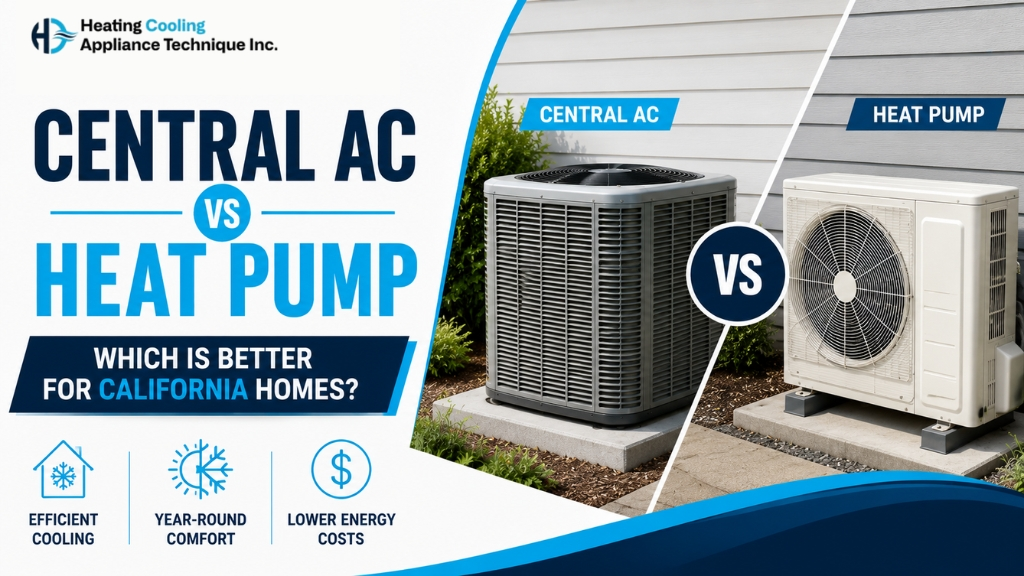
If you’re planning an HVAC upgrade in San Jose or anywhere in California, you’ve likely hit the big question: central AC vs heat pump—what actually makes more sense long-term?
In most California climates, especially the Bay Area, heat pumps are becoming the smarter all-in-one solution, but central AC still has strong advantages depending on your home, budget, and existing system.
This guide breaks everything down in plain English so you can confidently choose the right system for comfort, efficiency, and long-term savings.
What Is a Central AC System?
A central air conditioning system uses a split setup:
- Outdoor unit (compressor + condenser)
- Indoor evaporator coil
- Furnace (for heating in most homes)
How it works:
Central AC removes heat from indoor air and pushes it outside, cooling your home through ductwork.
Key point:
It only cools—you still need a furnace or gas heating system for winter.
What Is a Heat Pump System?
A heat pump is a two-in-one HVAC system that provides:
- Cooling in summer (like an AC)
- Heating in winter (by reversing refrigerant flow)
Instead of generating heat, it moves heat from outside air into your home, even in cooler temperatures.
Types commonly used in California:
- Ducted heat pump systems
- Ductless mini-splits
- High-efficiency inverter heat pumps
Central AC vs Heat Pump (Side-by-Side Comparison)
| Feature | Central AC | Heat Pump |
| Cooling performance | Strong | Strong |
| Heating capability | Requires furnace | Built-in |
| Energy efficiency | Moderate | High |
| Installation cost | Lower upfront | Higher upfront |
| Operating cost | Higher (dual system) | Lower long-term |
| Best climate | Any | Mild climates (like California) |
| Maintenance | Two systems | One system |
Why Heat Pumps Work So Well in California
California’s climate—especially in San Jose—is a major reason heat pumps are gaining popularity.
1. Mild winters = perfect efficiency match
Heat pumps don’t need extreme cold performance, so they run efficiently most of the year.
2. Lower electricity consumption
Modern systems are designed for energy-efficient home cooling and heating, reducing monthly utility bills.
3. One system instead of two
You eliminate the need for a separate furnace in many homes, reducing maintenance complexity.
4. State energy incentives
California promotes electrification, meaning rebates and incentives often support heat pump upgrades.
When Central AC Still Makes More Sense
Despite the shift toward electrification, central AC systems still make sense in certain cases:
- You already have a working gas furnace
- Lower upfront budget is the priority
- Your ductwork is optimized for existing split systems
- You only want a cooling upgrade (not heating replacement)
In these cases, central AC installation in California can be the more cost-effective short-term solution.
Heat Pump Benefits California Homeowners Should Know
Here’s where heat pumps really stand out:
Energy efficiency
Heat pumps can deliver up to 3x more heating energy than the electricity they consume.
Year-round comfort
No switching systems—cooling and heating are integrated.
Quiet operation
Modern inverter systems run significantly quieter than older AC units.
Environmental advantage
Lower carbon footprint compared to gas-based heating systems.
Expert HVAC Insight (From Field Experience)
At Heating, Cooling & Appliance Technique Inc, we consistently see a shift:
Homeowners upgrading older AC systems are increasingly choosing heat pumps—not because they’re trendy, but because they solve two real problems:
- Rising electricity and gas costs
- Desire for simpler, low-maintenance systems
However, we still recommend evaluating:
- Existing duct condition
- Home insulation quality
- Electrical panel capacity
- Long-term residency plans
Because the “best HVAC system for California homes” isn’t one-size-fits-all—it depends on usage patterns.
Central AC vs Heat Pump — Which Should You Choose?
Choose Central AC if:
- You already have a gas furnace in good condition
- Budget is tight
- You only need cooling replacement
Choose Heat Pump if:
- You want long-term energy savings
- You’re upgrading a full HVAC system
- You prefer one system for both heating and cooling
- You want to reduce gas dependency
Expert Tips Before You Decide
Here are practical HVAC insights most homeowners overlook:
1. Don’t ignore insulation
Even the best system underperforms in poorly insulated homes.
2. Duct condition matters
Leaky ducts can reduce efficiency by 20–30%.
3. Right sizing is critical
Oversized systems cycle inefficiently; undersized systems struggle in peak heat.
4. Ask about inverter technology
Variable-speed systems deliver smoother comfort and better efficiency.
FAQ
Is a heat pump better than central AC in California?
Yes, in most California climates, heat pumps are more energy-efficient because they provide both heating and cooling in one system.
Does a heat pump replace a furnace?
Yes. A heat pump replaces both the air conditioner and furnace in many homes, especially in mild climates like San Jose.
Are heat pumps expensive to run?
No. Heat pumps are generally cheaper to operate than systems that rely on gas furnaces, especially in moderate temperatures.
What is the lifespan of a heat pump vs AC?
Both systems typically last 12–15 years, but heat pumps may run year-round, so maintenance quality plays a big role.
What is the best HVAC system for California homes?
For most homeowners in coastal and Bay Area regions, heat pumps are currently the most energy-efficient and future-ready option.
Conclusion — What’s the Smart Choice?
When comparing central AC vs heat pump, the decision comes down to long-term value vs upfront cost.
- If you want the lowest initial expense → central AC may work
- If you want efficiency, comfort, and future-ready technology → heat pump wins for most California homes
For homeowners in San Jose, upgrading to a heat pump is increasingly becoming the practical, energy-conscious choice—especially as electricity and gas costs continue to rise.
If you’re unsure which system fits your home, a professional HVAC evaluation can help you avoid costly mistakes and choose a system that actually performs in real-world conditions.