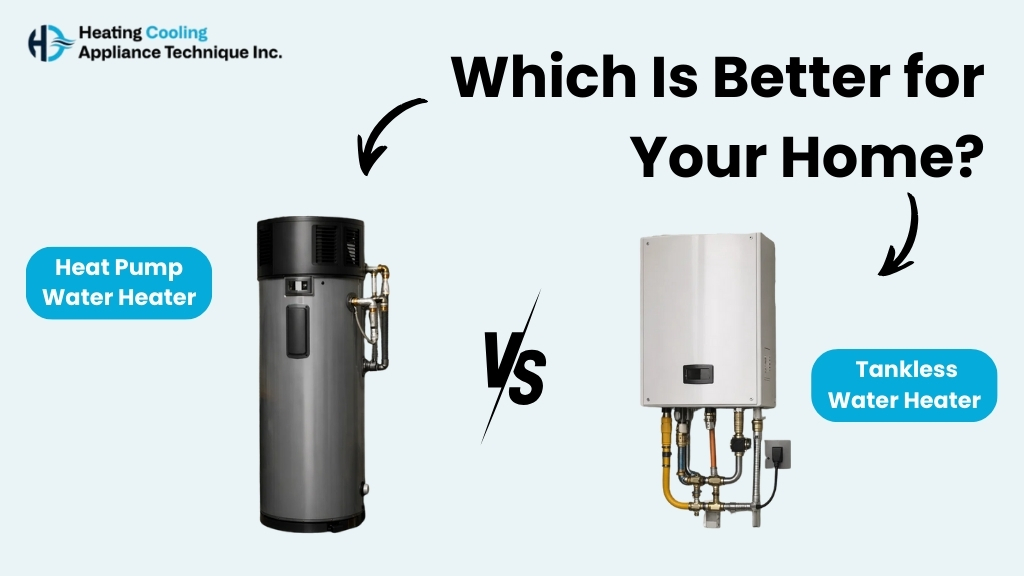
If your current water heater is limping along (lukewarm showers, weird noises, rising energy bills), upgrading feels like a simple decision—until you hit the big fork in the road: heat pump vs tankless. Both are “modern” options. Both can save money compared to an old-school tank. And both come with trade-offs that matter a lot depending on your home, climate, and how your household actually uses hot water.
Which One Is Better?
Heat pump water heater is usually better if you…
- Want lowest operating cost and strong long-term savings
- Have space for a tank (often 50–80 gallons)
- Live in a moderate/warm climate or have a garage/basement utility area
- Want to take advantage of rebates and incentives (often more common for heat pumps)
Tankless water heater is usually better if you…
- Want endless hot water (long showers, big tubs, back-to-back use)
- Need to save space (small utility closet, tight floorplan)
- Prefer a unit that lasts longer on average and don’t mind higher upfront costs
- Have an existing gas setup (or you’re prepared to upgrade electric service for electric tankless)
Understanding the Two Technologies
What a heat pump water heater does
A heat pump water heater (HPWH) doesn’t “make” heat the way a traditional heater does. It moves heat from the surrounding air into the tank—kind of like a refrigerator in reverse.
Heat pump water heater benefits (in real life)
- Uses significantly less electricity than standard electric tanks
- Works best where the surrounding air is warm enough to “borrow” heat
- Can also dehumidify the space (a perk in humid areas)
What a tankless water heater does
Tankless units heat water on demand as it flows through the heater. No tank storing hot water—just fast heating when you turn on the tap.
Tankless water heater advantages (that people actually care about)
- Hot water doesn’t “run out” the same way a tank can
- Saves space—mounts on a wall
- Can be very efficient, especially when paired with smart usage habits
Heat Pump vs Tankless: The Key Differences That Affect Your Daily Life
1) Upfront cost vs monthly cost
This is where most decisions are won or lost.
Heat pump water heater
- Higher upfront cost than a basic tank
- Often lower monthly energy bills, especially replacing an older electric unit
- Rebates/incentives can offset the purchase price (varies by region)
Tankless water heater
- Often higher upfront cost, especially when you include installation upgrades
- Operating cost depends heavily on:
- fuel type (gas vs electric)
- incoming water temperature (cold climates require more energy)
- usage pattern (lots of short uses can reduce efficiency gains)
Bottom line: If you’re focused on long-term savings, a heat pump often wins. If you’re focused on lifestyle + space, tankless can be worth it.
2) Hot water capacity and “endless” comfort
Heat pump water heater (tank-based)
You have a set amount of hot water stored. Once it’s used up, recovery takes time.
Best for:
- families with predictable shower schedules
- homes that want efficiency more than “unlimited hot water”
Watch-outs:
- back-to-back showers + laundry + dishwasher can drain the tank fast if it’s undersized
Tankless
Heats continuously—but it can be limited by flow rate. If too many fixtures run at once, you can get reduced temperature or pressure.
Best for:
- long showers, large tubs, high-demand households
- homes where hot water use stacks up back-to-back
Watch-outs:
- simultaneous use (two showers + dishwasher) may require a larger unit or multiple units
3) Energy efficiency: what actually matters
When people search “best water heater for home,” they often assume tankless is automatically the most efficient. Not always.
Heat pump efficiency
Heat pumps can be extremely efficient because they move heat rather than generate it. That’s a big part of why the heat pump water heater benefits show up on utility bills.
Best efficiency conditions:
- warm/temperate spaces
- steady daily hot water use
Efficiency can drop if:
- installed in very cold spaces without enough ambient heat
- the unit frequently switches to backup resistance heating (on some models)
Tankless efficiency
Tankless can be efficient because it avoids “standby losses” (keeping a tank hot all day). But real-life efficiency depends on:
- how often you use hot water
- how cold the incoming water is
- whether the unit is properly sized and vented (gas) or properly powered (electric)
4) Installation: the hidden decision-maker
Installation is where “simple swap” becomes “bigger project.”
Heat pump water heater installation notes
- Needs space and airflow
- Can be louder than a standard tank (think: a gentle HVAC hum)
- Often needs a drain or condensate management
- Works great in garages, basements, utility rooms (depending on climate)
Tankless installation notes
- Gas tankless may require venting changes and gas line sizing
- Electric tankless often needs significant electrical upgrades (amperage/panel capacity)
- Water quality matters more (hard water can increase scaling)
Rule of thumb: If you want the easiest upgrade path, replace what you already have with the closest match—unless you’re ready for panel/gas/vent upgrades.
5) Space, noise, and “where will it live?”
Heat pump water heater
- Takes floor space like a normal tank
- Needs room air to operate efficiently
- Can cool/dehumidify the room—great in some homes, annoying in others
Tankless
- Wall-mounted and compact
- Great for tight utility closets or small homes
- Typically quieter overall (though some units have noticeable burner/fan sounds)
What’s Best for Your Home?
Heat pump water heater is often best for:
- Homes replacing an older electric tank
- Households wanting lower monthly bills
- Garages/basements/utility rooms with enough airflow
- Homeowners planning to stay put long enough to benefit from energy savings
Tankless is often best for:
- Homes with high hot water demand (big families, soaking tubs, multiple showers)
- Small homes or tight utility spaces
- Homeowners with existing gas infrastructure (often smoother install)
- People who value “endless hot water” as a lifestyle upgrade
Common Mistakes to Avoid
1) Undersizing either system
- Too-small heat pump tank = hot water runs out
- Too-small tankless = weak flow/temperature drops during simultaneous use
2) Ignoring your water quality
Hard water can shorten lifespan and increase maintenance—especially for tankless.
3) Assuming the “most efficient” is always best
The best water heater for home is the one that fits your usage, space, climate, and install realities.
Conclusion
If you want the most consistent long-term energy savings and you’ve got the space, a heat pump water heater is often the better all-around choice—one of the biggest heat pump water heater benefits is how much it can reduce electricity use compared to older electric tanks.
If you want endless hot water, a compact footprint, and you’re okay investing more upfront (especially for installation), tankless is a strong upgrade—and the tankless water heater advantages are hard to beat for comfort and space.