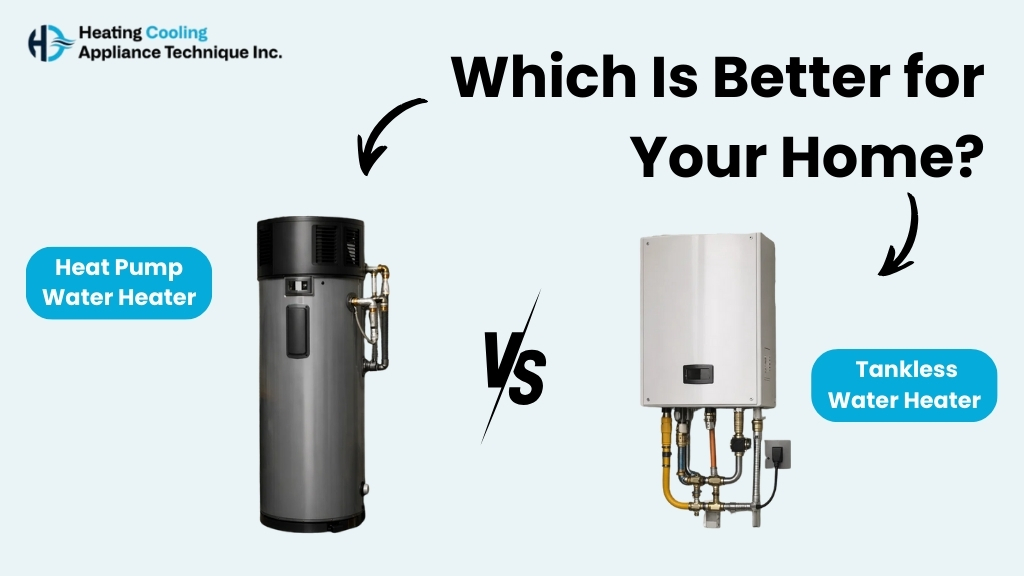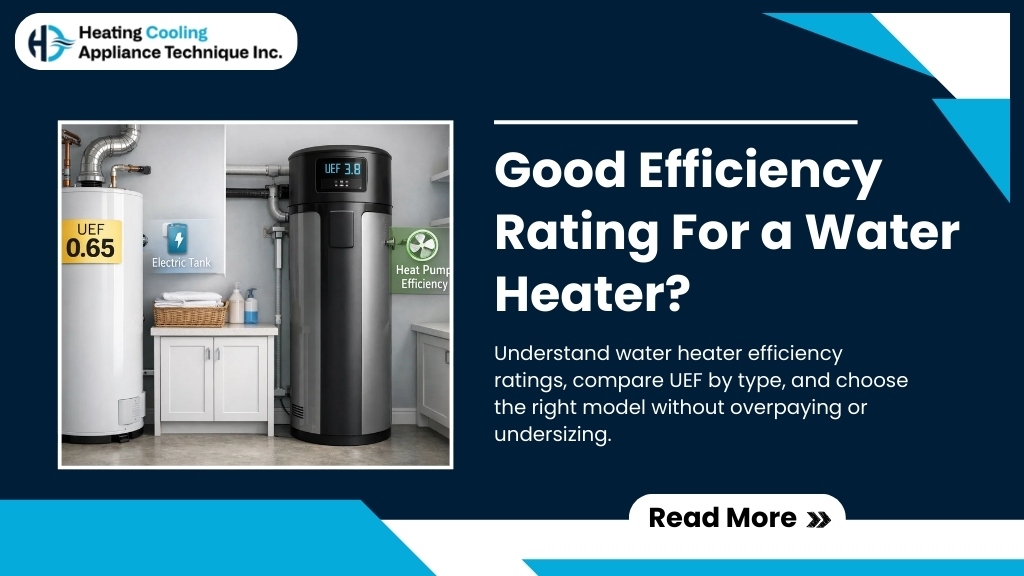
If you’ve ever shopped for a water heater, you’ve probably noticed the efficiency numbers feel… weird. One model says 0.65, another says 0.93, and heat pump units show 3.5+ like they’re playing a different sport.
A “good” water heater efficiency rating depends on the type of water heater, your household hot-water demand, and the rating system used (EF vs UEF water heater). The goal is simple: more hot water for less energy—without buying a unit that’s overkill for your home.
What Does Water Heater Efficiency Rating Mean?
A water heater’s efficiency rating tells you how effectively it converts fuel/electricity into hot water—including the energy it wastes while the water sits in the tank and as the unit cycles on/off.
The most common rating you’ll see today: UEF
UEF (Uniform Energy Factor) is the modern standard used on most residential water heaters. Higher is better. A higher UEF typically means lower operating costs when comparing similar models.
One important “gotcha”: UEF uses usage categories (“bins”)
UEF comparisons are intended within the same usage bin, which is based on hot-water demand (linked to things like first-hour rating for tank models). In other words: compare apples to apples.
What Is Considered a Good Efficiency Rating for a Water Heater?
Here’s the practical answer most homeowners want: a “good” rating is one that’s above the typical baseline for that heater type.
Typical “good” targets by water heater type (rule-of-thumb)
1) Standard electric tank (resistance)
- Good: ~0.90–0.95 UEF
- These are naturally efficient at turning electricity into heat, but they can still lose heat sitting in the tank.
2) Standard gas tank (non-condensing)
- Good: ~0.60–0.70 UEF
- This is “normal” for many gas tanks; jumping higher usually means different tech (condensing or tankless). A range around 0.60–0.65 is commonly cited for minimum-efficiency gas storage units.
3) Tankless gas (non-condensing vs condensing)
- Good: 0.80–0.90+ UEF
- Very good / high efficiency: ~0.90–0.95 UEF
- ENERGY STAR tax-credit-eligible tankless models are often ≥ 0.95 UEF.
4) Heat pump (hybrid) water heater
- Good: ~3.0+ UEF
- Very good / high efficiency: ~3.3 to 4.1 UEF is common for ENERGY STAR heat pump water heaters.
So… what’s the “best water heater efficiency”?
If you’re chasing best water heater efficiency (pure operating cost and energy use), heat pump water heaters usually win by a mile because they move heat rather than create it. That’s why their UEF numbers look so much higher.
But the “best” choice still depends on your home (space, climate, electric panel capacity, venting, gas availability, hot-water demand, etc.).
EF vs UEF: Which Water Heater Efficiency Rating Matters Most?
EF (Energy Factor) = the older label
EF was the long-time efficiency metric you’d see on older models and older articles.
UEF (Uniform Energy Factor) = the current standard
UEF replaced EF as the DOE-backed way to compare water heaters, with standardized usage patterns (bins).
Which one should you use?
- If you’re shopping today: focus on UEF
- If you’re reading older spec sheets or comparing an existing unit: EF can still be useful, but don’t mix EF and UEF numbers and assume they’re identical.
Bottom line: for real-world shopping decisions in 2026, UEF is the number that matters most.
Electric vs Gas Water Heater Efficiency: What’s “Good” in Real Life?
This is where people get tripped up: efficiency rating isn’t the same thing as “cheapest to run.”
Electric (standard tank) vs Gas (standard tank)
- Electric tanks often show higher UEF than standard gas tanks.
- But in many areas, electricity costs more per unit of heat than natural gas—so gas can still be cheaper to operate even with a lower efficiency number.
Heat pump electric vs Gas
Heat pump water heaters usually deliver the biggest savings potential because their efficiency is so high (those 3.3–4.1 UEF numbers are the clue).
Tankless: efficiency vs comfort
Tankless can be efficient (especially condensing models), but “good” depends on:
- your flow needs (two showers at once?)
- incoming water temperature (colder water = more work)
- gas line size and venting requirements
So when comparing electric vs gas water heater efficiency, use UEF as a starting point—but also check install requirements and local energy prices.
What Is a High-Efficiency Water Heater in Today’s Market?
A high efficiency water heater usually means the unit uses technology that reduces standby loss and/or captures more heat from the fuel source.
Common “high efficiency” categories
1) Heat pump (hybrid) tank
- Often considered the efficiency champ in typical homes
- ENERGY STAR heat pump units commonly land around 3.3–4.1 UEF
2) Condensing gas storage or condensing tankless
- Designed to extract more heat from exhaust gases
- Tankless gas models eligible for credits often start around 0.95 UEF
3) ENERGY STAR-certified models (quick shortcut)
ENERGY STAR uses UEF-based criteria to define higher-performing models.
Example: ENERGY STAR notes gas-fired storage residential-duty commercial units at UEF ≥ 0.86 (category-specific).
Also, ENERGY STAR tax-credit guidance highlights gas storage thresholds like ≥ 0.81 UEF (<55 gal) and ≥ 0.86 UEF (≥55 gal).
(Criteria can vary by product class and size, so use ENERGY STAR as a filter, then compare within your heater type.)
How to Pick a “Good” Efficiency Rating Without Overbuying
Here’s the smartest way to choose the right water heater efficiency rating for your home.
1) Match efficiency to your hot-water demand
A super-efficient unit that’s undersized will annoy you daily. Look at:
- household size
- back-to-back shower use
- laundry/dishwasher patterns
- first-hour rating (for tanks)
UEF bins are tied to usage patterns and first-hour performance, which is why comparisons work best within the same bin.
2) Decide what you’re optimizing for
- Lowest monthly bill → heat pump or condensing tech
- Lowest upfront cost → standard tank
- Endless hot water feel → tankless (properly sized)
- Simple + reliable → standard tank, but choose the best UEF you can within budget
3) Don’t ignore installation realities
This is the hidden dealbreaker for “best water heater efficiency”:
- Heat pumps need space + airflow (and they cool/dehumidify the room)
- Condensing gas may need different venting and a drain for condensate
- Tankless may require gas line upgrades
A high-efficiency unit installed poorly can lose a chunk of its advantage.
Quick FAQ
Is a higher UEF always better?
Generally yes—within the same heater type and usage bin. UEF is designed to compare performance under standardized draw patterns.
What’s a good UEF for a gas water heater?
For many standard gas tanks, ~0.60–0.70 UEF is common; higher usually means tankless or condensing tech.
What’s a good UEF for an electric water heater?
Standard electric tanks are often around 0.90–0.95 UEF, while heat pump models jump much higher.
What UEF is considered “high efficiency” for heat pump water heaters?
A common benchmark is ~3.3+ UEF, and many ENERGY STAR heat pump units land around 3.3–4.1 UEF.
Should I care about EF anymore?
Only if you’re looking at older documentation or an older unit. For modern shopping and labels, UEF is the main number to use.
Conclusion
A good efficiency rating isn’t one magic number—it’s the best UEF you can get within your water heater category, sized correctly for your household.
If you want the simplest cheat code:
- Standard gas tank: aim for the higher end of its typical range
- Standard electric tank: 0.90+ UEF is a solid target
- High efficiency water heater: look at heat pump (3.3+ UEF) or condensing gas/tankless (0.90–0.95 UEF)