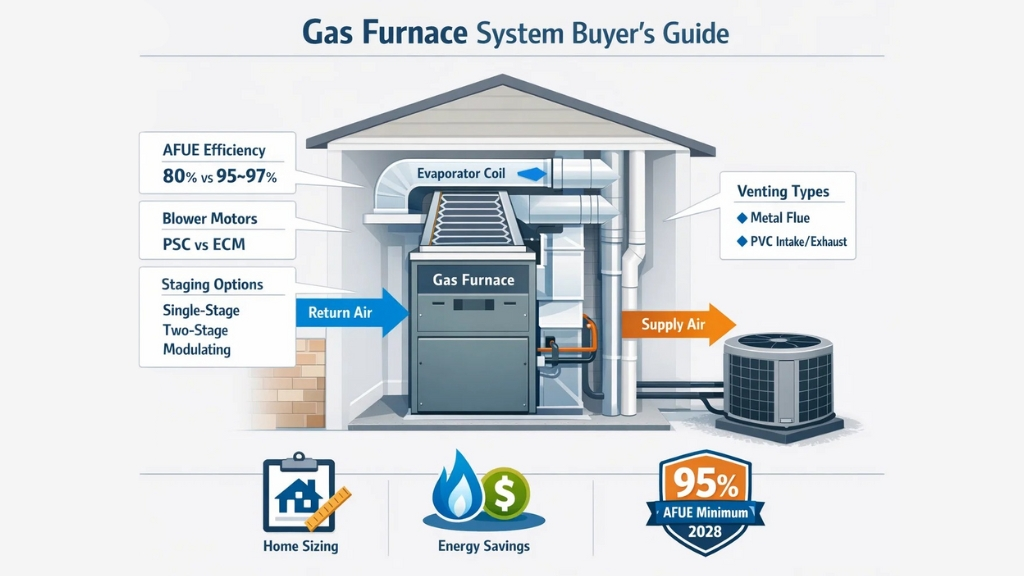
When you want powerful, reliable heat and a central AC option for summer, a gas furnace system (gas furnace + indoor coil + optional outdoor AC/heat pump) is the classic, serviceable choice. Modern bundles come in upflow, downflow, and horizontal configurations to fit basements, closets, attics, or crawlspaces, with sizes to match small homes up to light-commercial spaces.
What’s in a “Gas Furnace System”?
A typical bundle includes:
- Gas furnace (the heater + blower)
- Evaporator coil (sits on top or in front of the furnace)
- Optional outdoor unit (air conditioner or heat pump) for cooling
Retailers group these as “systems” so you can pick airflow (upflow/downflow/horizontal), capacity, and efficiency together.
AFUE, explained in plain English
AFUE (Annual Fuel Utilization Efficiency) is the percent of fuel that becomes useful heat over a season.
- 80% AFUE: 80 out of 100 fuel BTUs heat your home; 20% exits via flue
- 95–97% AFUE: condensing furnaces that recapture more heat from exhaust
Higher AFUE = lower gas waste (duct losses are separate).
What’s changing in 2028?
The U.S. Department of Energy finalized a national 95% AFUE minimum for most residential gas furnaces, effective late 2028. In practice, that phases out most non-condensing models at manufacture. If you’re replacing after that date, expect condensing technology to be the baseline.
Key Specs That Actually Matter
- Capacity (BTU input/output): Match to a load calc (Manual J). Oversizing causes short cycling and cold spots; undersizing struggles in cold snaps.
- AFUE & Combustion Type:
- 80% AFUE (non-condensing): simpler venting (metal flue), lower upfront cost
- 95–97% AFUE (condensing): PVC venting, drains condensate, lower gas use
Many retailers show both ranges in stock—useful if you’re replacing pre-2028 or in special cases.
- Blower Motor:
- PSC (single speed) – basic
- ECM (multi/variable speed) – quieter, better comfort, helps with SEER2 on cooling paired systems
- Staging:
- Single-stage: on/off
- Two-stage: longer, gentler heat cycles
- Modulating: tightest temperature control and quietest operation
- Cooling Pairing: Many furnace bundles pair with R-32 outdoor AC units (newer refrigerant with lower GWP) and list modern SEER2 cooling ratings.
- Airflow Configuration: Upflow / Downflow / Horizontal options let you fit basements, closets, attics, or crawlspaces without rewiring the house.
Sizing: Quick Reality Check
- Get a load calc (Manual J) or use square-footage only as a rough start.
- Adjust for your home: insulation, windows, ceiling height, infiltration, occupants, and local design temps.
- Ducts matter: An 80k furnace on undersized/ leaky ducts won’t feel like an 80k system.
- Don’t oversize for “just in case.” If you need “headroom,” consider two-stage or modulating instead.
Venting & Installation Basics (what pros get right)
- Venting:
- 80%: metal B-vent into chimney/flue
- 95–97%: PVC intake/exhaust + condensate drain; obey vent length and termination rules
- Combustion air: sealed combustion on condensing models helps indoor air quality and efficiency
- Gas & electrical: correct gas pressure, drip leg, shutoff, dedicated circuit, code-compliant disconnect
- Startup: clock input, verify temperature rise, static pressure, and safety controls
Maintenance (protect your warranty + comfort)
- Replace/clean filters (1–3 months typical)
- Annual combustion check, condensate/heat exchanger inspection
- Keep coil and outdoor unit clean for cooling season performance
Common Buying Paths
- Budget replacement today: 80% AFUE single-stage (pre-2028 installs where allowed)
- Long-term ownership: 96–97% AFUE two-stage or modulating + ECM
- Best comfort year-round: 96–97% AFUE furnace + high-SEER2 A/C (often R-32) with variable-speed blower for quieter airflow.
FAQs
Is gas heat cheaper to run than electric heat?
Usually, yes—especially versus resistance heat—though local fuel rates matter. AFUE tells you how much of that gas becomes useful heat. T
Will 80% furnaces still be available?
The DOE rule moves the minimum to 95% AFUE in late 2028, which effectively retires most new 80% models at manufacture. Existing installed equipment can be serviced.
Can I pair a new furnace with my existing A/C?
Often, yes—but match blower/coil size, metering device, and controls. If you’re upgrading cooling too, look at SEER2-rated bundles (many use R-32).