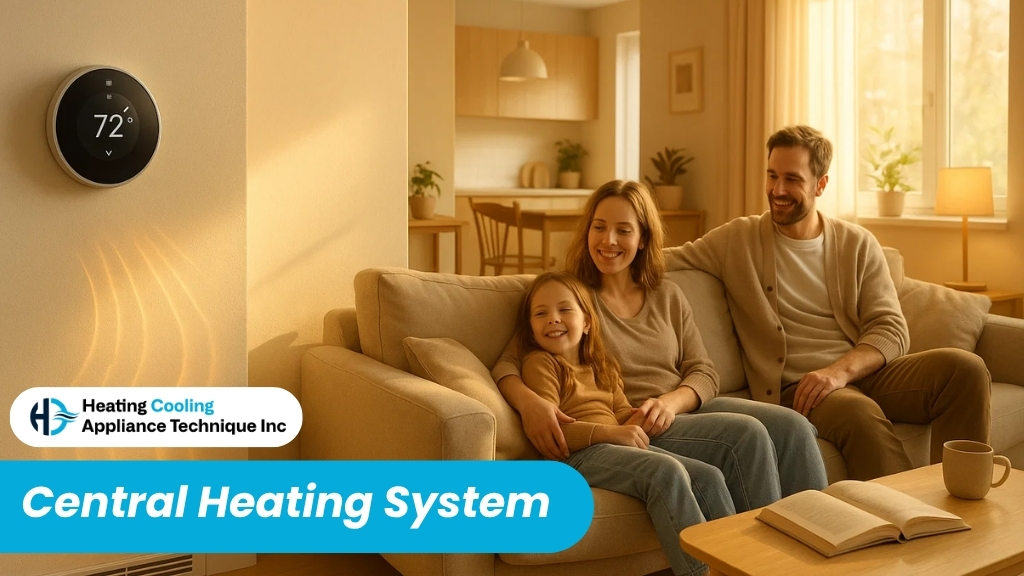
A central heating system uses one main heat source to warm your entire home and distributes that heat through ducts or pipes so every room stays consistent. Think of it as a single engine driving comfort everywhere—no space heaters, no cold corners.
What Counts as “Central” Heat?
“Central” simply means one system serves multiple rooms. That can be forced-air (a furnace or heat pump moving warm air through ducts) or hydronic (a boiler circulating hot water to radiators, baseboards, or in-floor tubing). Many homes in the U.S. use a furnace or a boiler as their main heat source.
Main System Types (and where they fit)
- Gas Furnace + Coil (with optional AC/Heat Pump outside)
The classic ducted setup. You pick airflow orientation (upflow/downflow/horizontal) to fit basements, closets, attics, or crawlspaces. Great if you already have ductwork and want strong, fast heat plus central cooling. - Central Heat Pump (Split System)
One system for heating and cooling. It moves heat in winter and reverses for summer cooling—still using your ductwork. Higher-efficiency options can lower energy use compared with resistance heat. Hybrid “dual-fuel” pairings (heat pump + gas furnace) are common in mixed climates. - Boiler (Hydronic/Combi)
Heats water and sends it to radiators/baseboards or radiant floors for even, quiet warmth. A combi boiler also provides domestic hot water on demand in a compact package. Best for homes without ducts or where radiant heat is preferred.
The Key Numbers That Actually Matter
- AFUE (furnaces): Seasonal fuel efficiency (80% vs. 95–97%+ on condensing models). The U.S. DOE has adopted higher minimums over time; understanding AFUE helps estimate gas use.
- HSPF2 & SEER2 (heat pumps): Heating and cooling efficiency under the newer 2023 test procedures; modern ducted heat pumps list both so you can compare apples to apples.
- Capacity (BTU/tons): Match the system to your home’s heat loss/gain. Bigger isn’t better—oversizing causes short cycling, noise, and uneven comfort.
- Airflow configuration (forced-air): Upflow/downflow/horizontal to fit the space; central pages showcase multi-positional options.
- Controls: From basic thermostats to smart learning stats and hotel-style controllers, the right control helps tune comfort and savings.
Sizing: Quick Framework That Prevents Regret
- Start with a load calculation (Manual J). Square-foot rules are only rough.
- Adjust for reality: insulation, window area/orientation, ceiling height, air leakage, occupancy, and local design temps.
- Mind the distribution: Duct size/condition (forced-air) or radiator/baseboard length (hydronic) can bottleneck comfort even if equipment is right.
Installation Basics (what good pros do)
- Ducted systems: Check static pressure, seal and insulate ducts, and match blower/coil to outdoor unit if you’re adding AC/heat pump. Multi-positional units make tight spaces easier.
- Hydronic systems: Correct pump sizing, air elimination, and zoning valves for quiet operation and balanced temps.
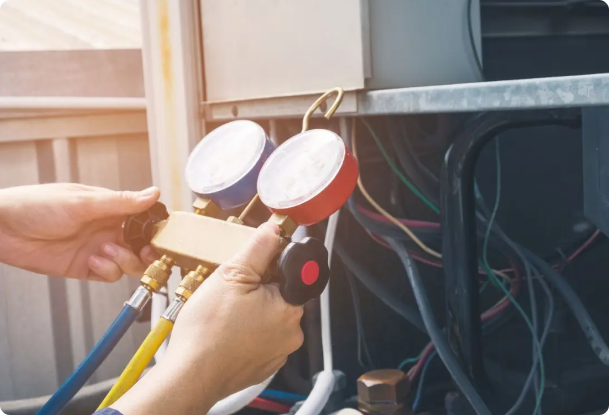
- Heat pumps: Verify line set integrity, evacuation/charge to spec, and proper setup of defrost/thermostat wiring.
- Commissioning: Measure temperature rise, verify airflow, confirm safety limits, and set thermostat profiles.
Maintenance (protect efficiency and comfort)
- Forced-air: Replace/clean filters (1–3 months), keep coils clean, inspect condensate drains, and schedule annual service.
- Hydronic: Bleed air, check expansion tank pressure, confirm pump/valve performance, and service the boiler annually.
- Controls: Update firmware (where applicable) and review schedules/eco modes each season.
Which Path Fits Common Scenarios?
- Have ducts and want the lowest hassle: Gas furnace + AC (or furnace + heat pump for hybrid).
- Want one system for heat + cool with lower carbon footprint: Central heat pump split system.
- No ducts and prefer radiant comfort: Hydronic boiler or combi boiler solution.
FAQs
Is a heat pump “central heating”?
Yes. A ducted split heat pump is a central system that heats and cools through your home’s ductwork.
Do boilers count as central heat?
Yes. A boiler is a central source that sends hot water/steam to multiple rooms via radiators/baseboards, delivering whole-home heat without ducts.
What makes one system “more efficient” than another?
For furnaces, AFUE; for heat pumps, HSPF2 (heat) and SEER2 (cooling). Right-sized equipment plus solid ducts/piping and controls usually beats chasing nameplate numbers alone.